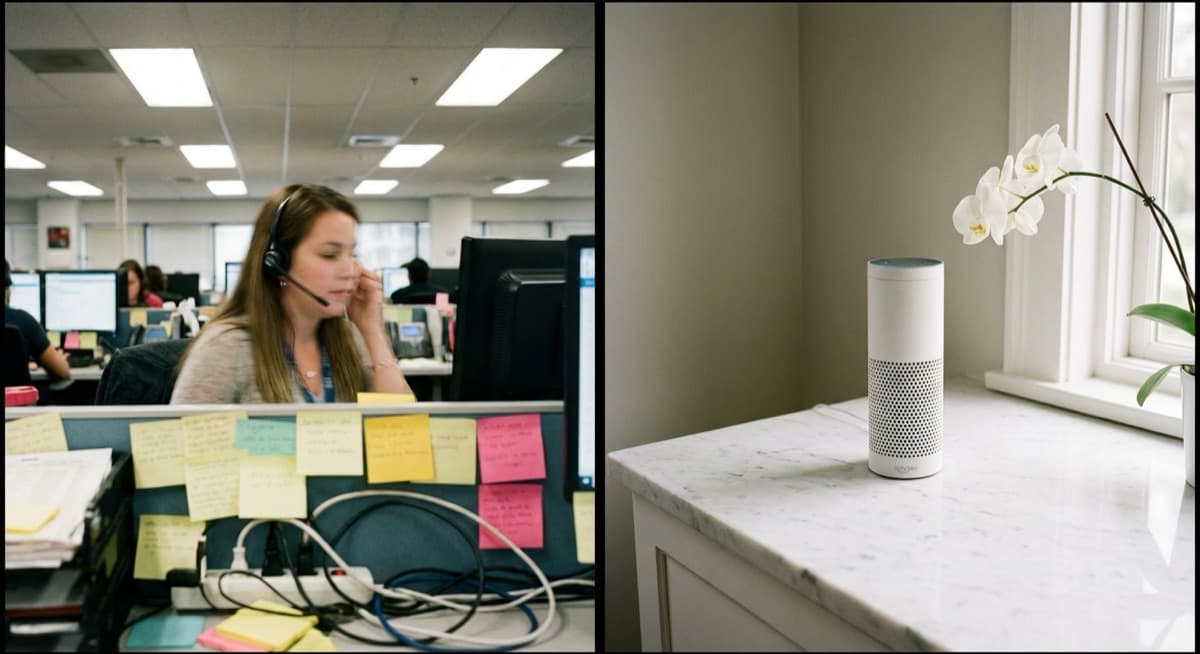
If you are exploring options to handle incoming business calls without hiring a full-time front desk employee, you have likely come across two popular solutions: AI receptionists and virtual receptionists. Both promise to keep your phone lines covered, but they work in fundamentally different ways and serve different business needs.
This guide breaks down the AI receptionist vs virtual receptionist comparison across the factors that matter most: cost, availability, consistency, scalability, personalization, and setup time. By the end, you will have a clear picture of which solution fits your business.
What Is a Virtual Receptionist?
A virtual receptionist is a real person who answers your business calls from a remote location. These agents typically work for a call center or answering service company and handle calls for multiple businesses throughout the day. They follow scripts you provide, take messages, transfer calls, and can perform basic tasks like appointment scheduling.
Virtual receptionists have been the go-to alternative to in-house staff for decades. They bring human warmth and conversational flexibility to every interaction. However, because they are real people, their availability and capacity are limited by staffing and shift schedules.
What Is an AI Receptionist?
An AI receptionist is a software-powered system that answers phone calls using artificial intelligence. Modern AI receptionists, like Callis, use natural language processing to understand callers, respond conversationally, answer questions about your business, book appointments, and route calls, all without human intervention.
Unlike basic phone trees or IVR systems from the past, today's AI receptionists carry on fluid, natural conversations. They are trained on your specific business information, so callers get accurate answers about your services, hours, pricing, and policies.
Head-to-Head Comparison
Cost

This is often the deciding factor. Virtual receptionists typically cost between $200 and $1,000 per month, depending on the plan. Most pricing is based on call volume or minutes used, which means your bill increases as your business grows. Higher-tier plans that include 24/7 coverage or dedicated agents can push costs well above $1,000.
AI receptionists operate on a flat-rate model. Callis, for example, costs $399 per month for unlimited 24/7 call handling. There are no per-minute charges, no overage fees, and no surprise bills at the end of the month. For businesses that handle a high volume of calls, the savings can be significant.
Bottom line: If you receive a low volume of calls during business hours only, a basic virtual receptionist plan might be cheaper. For anything beyond that, an AI receptionist offers far more predictable and often lower costs.
Availability

Virtual receptionists are constrained by human schedules. Standard plans cover business hours (roughly 9 AM to 5 PM). Some services offer extended hours or 24/7 coverage, but this comes at a premium and may mean your after-hours calls are handled by less experienced overnight staff.
AI receptionists are available 24 hours a day, 7 days a week, 365 days a year with no degradation in quality. There are no holidays, no sick days, and no shift changes. A call at 2 AM on a Sunday gets the same quality of service as a call at 10 AM on a Tuesday.
For businesses like medical practices, legal firms, home service companies, and real estate agencies where calls come in around the clock, true 24/7 availability is not a luxury. It is a competitive advantage.
Consistency
Every caller to your business forms an impression based on their phone experience. With virtual receptionists, that experience varies. Different agents may handle your calls on different days. Some might be more familiar with your business than others. Tone, accuracy, and attentiveness can fluctuate depending on the agent, their workload, or how many other businesses they are serving at that moment.
An AI receptionist delivers the same experience on every single call. It follows the same protocols, uses the same tone, and provides the same accurate information whether it is the first call of the day or the five hundredth. There is no variance in mood, attentiveness, or knowledge.
Scalability
Scalability is where the gap between the two solutions widens dramatically.
Virtual receptionist costs scale linearly with call volume. If your call volume doubles, your bill roughly doubles. If you run a seasonal business with sharp spikes (think HVAC companies in summer or tax firms in spring), you either overpay during slow months or scramble for capacity during peak periods.
AI receptionists handle unlimited concurrent calls at the same flat rate. Ten calls at once? No problem. A sudden spike because your ad campaign went viral? Every call still gets answered on the first ring. There is no queuing, no hold music, and no callers sent to voicemail because all agents are busy.
Personalization and Human Touch
This is where virtual receptionists have a genuine advantage. A skilled human agent can read emotional cues, adapt to unexpected situations, and provide empathy in ways that AI cannot fully replicate. If a caller is distressed, confused, or dealing with a sensitive situation, a human receptionist can adjust their approach in real time.
AI receptionists have made remarkable progress in natural conversation, but they are not a perfect substitute for human intuition in every scenario. Complex emotional interactions, highly nuanced negotiations, or callers who are upset and need someone to truly listen are situations where a human touch still matters.
That said, the majority of business calls are routine: scheduling appointments, asking about hours and pricing, requesting callbacks, or getting directions. For these calls, which typically make up 80% or more of inbound volume, an AI receptionist performs just as well as, and often better than, a human agent because it never rushes, never forgets details, and never puts a caller on hold.
Setup Time
Virtual receptionist services typically require one to two weeks to get fully operational. You need to create call scripts, train the team on your business, set up call forwarding, and go through a testing period. Ongoing updates to your scripts or business information may take days to propagate across all agents.
AI receptionists can be set up in days. With Callis, you provide your business information, customize the AI's responses and personality, and go live. Updates take effect immediately because you are modifying a single system rather than retraining a team of people.
When to Choose a Virtual Receptionist
A virtual receptionist may be the better choice if:
- Your call volume is very low (under 50 calls per month) and a basic plan is cost-effective
- Your business regularly handles emotionally sensitive calls where human empathy is essential, such as grief counseling or crisis hotlines
- You need your receptionist to perform complex tasks beyond call handling, like processing detailed intake forms that require back-and-forth judgment calls
- Your callers are predominantly elderly or non-tech-savvy and strongly prefer speaking with a human
When to Choose an AI Receptionist
An AI receptionist is the stronger choice if:
- You need true 24/7 coverage without paying premium rates for after-hours service
- Consistency matters because your brand depends on every caller getting the same high-quality experience
- Your call volume is growing and you need a solution that scales without ballooning costs
- Speed of setup matters and you want to be live in days, not weeks
- You handle a high volume of routine calls like appointment booking, FAQs, and call routing
- You want predictable monthly costs with no per-minute billing surprises
The Practical Middle Ground
It is worth noting that AI receptionists and virtual receptionists are not mutually exclusive. Some businesses use an AI receptionist like Callis to handle the bulk of everyday calls while keeping a human answering service on standby for the small percentage of calls that require a personal touch. This hybrid approach gives you the cost efficiency and scalability of AI with the human fallback for edge cases.
Making Your Decision
The AI receptionist vs virtual receptionist decision comes down to what your business values most. If you prioritize cost predictability, 24/7 availability, unlimited scalability, and rock-solid consistency, an AI receptionist is the clear winner. If your business deals primarily in sensitive, emotionally complex interactions where human empathy is non-negotiable, a virtual receptionist may serve you better.
For most small and mid-sized businesses, the math increasingly favors AI. The technology has matured to the point where callers often cannot tell the difference, and the operational advantages of always-on, always-consistent phone coverage are hard to ignore.
Want to hear the difference for yourself? Call Callis and experience how an AI receptionist handles a real conversation. No signup required.